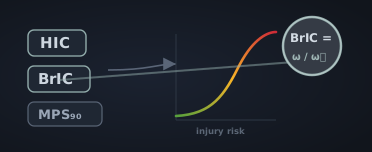
Long before anyone could simulate brain strain, engineers needed a way to put a number on how dangerous a blow to the head was. The car industry needed it to rate airbags; sports researchers borrowed the same toolkit. The result is a family of brain-injury criteria — formulas that take head kinematics and spit out a single severity score. They’re worth understanding, because trace* is in many ways a response to their limitations.
HIC — the original
The Head Injury Criterion (HIC) is the granddaddy, and it still sits inside car safety ratings today. It’s computed entirely from linear acceleration — how hard the head’s centre of mass speeds up or slows down — combined with how long that acceleration lasts. A short, sharp spike and a longer, gentler shove can produce the same HIC.
HIC did a real job: it captured the kind of injury that dominates car crashes — skull fracture and the severe, focal damage that comes from the head striking something hard. For that, linear acceleration is a sensible ingredient.
The problem HIC misses
The trouble is that most sports head injuries aren’t skull fractures. They’re diffuse — concussions and the microscopic stretching of white-matter fibres — and that kind of damage is driven less by how hard the head translates and more by how fast it rotates.
The intuition: the skull is a roughly rigid box, and the brain inside it is a soft jelly. Shove the whole box in a straight line and the jelly mostly goes along for the ride. Spin the box quickly and the jelly shears against itself, stretching the long fibres that run between regions. HIC, built on linear acceleration alone, is partly blind to this.
BrIC — putting rotation in
Enter the Brain Injury Criterion (BrIC), developed for exactly this gap. BrIC is built from rotational kinematics, scaling the head’s peak angular velocity in each direction against a critical value (Takhounts et al., 2013).
Two things about BrIC are worth remembering:
- It is explicitly a rotational criterion — a formal acknowledgement that spin, not just g-force, drives diffuse brain injury.
- Its developers found that peak rotational velocity, not rotational acceleration, was the better predictor of the simulated brain response. Field studies that instrumented real concussions in six degrees of freedom point the same way (Hernandez et al., 2015). This is why trace* leans on rotational-velocity features in its own model.
It’s not that linear acceleration is irrelevant — some analyses argue it remains a primary risk factor in its own right (Towns et al.) — but rotation is the piece the early criteria under-weighted.
Why the field moved to tissue strain
Even BrIC shares a deeper limitation with HIC: both are global numbers. They describe the head’s overall motion and hand you one score. They can’t tell you which part of the brain was loaded, and they treat every brain as mechanically identical.
The next step — the one trace* is built on — is to stop scoring the motion and start estimating the tissue response directly: how much each region of the brain actually stretched. Finite-element studies showed that strain-based measures predict injury more consistently than kinematic criteria like HIC across a range of impact conditions (Kleiven, 2006/2007). That’s why trace* doesn’t return a single HIC-style score. It returns a per-region strain map — closer to what’s happening inside the skull, and harder to game with a single lucky-looking number.
How to hold all this
Think of it as a ladder of fidelity:
- HIC — linear acceleration only. Great for crashes, blunt for sport.
- BrIC — adds rotation, which is what most sports injuries are about.
- Tissue strain (MPS) — skips the proxy entirely and estimates what the brain tissue did, region by region.
Each rung is more informative and more expensive to compute. trace*’s job is to deliver the top rung at the speed of the bottom one.
Sources & further reading
- Takhounts, E. G. et al. (2013) — Development of Brain Injury Criteria (BrIC). Stapp Car Crash Journal 57.
- Hernandez, F. et al. (2015) — Six degree-of-freedom measurements of human mild traumatic brain injury. Annals of Biomedical Engineering 43 (8).
- Kleiven, S. (2006/2007) — Evaluation of head injury criteria using a finite element model validated against experiments. SAE / IJCrash.
- Towns, S. et al. — Linear acceleration is a primary risk factor for concussion. — A reminder that linear and rotational metrics each capture part of the picture.