The single biggest problem with measuring brain strain isn’t accuracy — it’s speed. A finite-element brain model can tell you exactly how much each region deformed during an impact, but it takes 5–6 hours per impact on a compute cluster. That’s fine for academic studies and useless for a pitch-side tablet.
Machine learning is how trace* bridges that gap.
The setup
Imagine you have a teacher who answers any question perfectly but takes six hours to reply. You also have a student who answers immediately but only knows what they’ve been taught. What you want is a student who’s been shown enough of the teacher’s answers that they can guess the right reply on questions they haven’t seen.
That’s exactly the setup behind the trace* model (Chan et al., 2025):
- The teacher is the Imperial College FE brain model (Ghajari et al., 2017) — about a million tetrahedra representing skull, scalp, cerebrospinal fluid, brain, and ventricles. Validated against post-mortem human-subject experiments.
- The questions are 104-ms head-kinematic recordings from instrumented mouthguards. The training set is 1 701 elite male rugby impacts collected with the Protecht iMG.
- The answers are the MPS90 — the 90th-percentile maximum principal strain — in the whole brain and 17 regions of interest. (MPS90 rather than the absolute max, to avoid single-element numerical artefacts in the FE simulation.)
- The student is the machine-learning model — in trace*’s case, a family of eighteen tree-based regressors, one per region.
Why XGBoost?
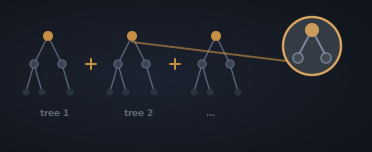
The algorithm trace* uses is called gradient boosting, and the implementation is called XGBoost. It works by chaining together hundreds of small decision trees, each one trained to correct the mistakes of the previous one. The result is a fast, accurate, well-understood model that handles tabular input well — exactly the shape of the data the mouthguard produces.
We tried other approaches first. Neural networks gave comparable accuracy but needed the full kinematic time series as input, which is hard to transmit from the touchline in real-time. XGBoost works from four scalar features extracted from each impact window, which is small enough to send over Bluetooth without compression.
What the model actually sees
The paper systematically scored every reasonable kinematic feature — peak values, oscillation counts, FFT components, area under the curve — against the strain it was trying to predict. Two features survived:
- Delta (max − min) of the resultant rotational velocity, RotVelRes.
- √|max| of the resultant rotational velocity, RotVelRes.
And the same two features applied to the resultant rotational acceleration channel (RotAccRes). That’s four scalar numbers per impact, transmitted as a 2 × 2 matrix.
The choice matters: existing mouthguard hardware can stream those four values to a pitch-side tablet reliably, but not the full 104-ms time series the deep-learning models would need.
Those four numbers go into eighteen pre-trained XGBoost models — one per region — and eighteen MPS90 estimates come out the other side. Inference takes milliseconds on an iPhone and similar in the browser.
How well does it do?
Across the 17 regions, the paper reports test-set R² values of 0.764 – 0.851 for XGBoost — essentially indistinguishable from an MLP using 20 features (R² 0.721 – 0.876) or a CNN using the full kinematic time series (R² 0.744 – 0.887). The headline finding: you can give up almost nothing in accuracy by going from a 104 × 6 input matrix to a 2 × 2 one, and you get orders of magnitude fewer floating-point operations in return.
Where it’s strong, where it’s weak
The model is strong when the impacts you give it look like the ones it was trained on — adult elite male rugby, with kinematics in the range the training cohort spanned. It’s less reliable at the extremes: very small impacts where the signal-to-noise ratio is low, and very severe impacts where the training set is sparse. We are actively expanding the training cohort to cover women’s rugby, youth grades, and other contact sports.
A surrogate model is only ever as good as the simulator it learned from. Subsequent work compares the IC-brain-model predictions against direct cadaver-impact measurements as an ongoing calibration check.
Sources & further reading
- Chan, E. Y. K., Yu, X., Qin, C. & Ghajari, M. (2025) — Balancing efficiency and accuracy: extreme gradient boosting and neural networks for near real-time brain deformation prediction in sports collisions. Engineering Applications of Artificial Intelligence 162, 112489. — The canonical trace* paper. Open access, CC BY-NC-ND 4.0.
- Chen, T. & Guestrin, C. (2016) — XGBoost: a scalable tree boosting system. KDD.
- Ghajari, M., Hellyer, P. & Sharp, D. (2017) — Computational modelling of traumatic brain injury predicts the location of chronic traumatic encephalopathy pathology. Brain 140 (2). — The Imperial College FE brain model used to generate the training labels.