Kinematic data
Instrumented mouthguards (iMGs) worn by athletes capture head kinematics data in both linear and rotational.
See the Impact.
Real-time brain strain prediction and pitch-side assessment for safer play.
Instrumented mouthguards (iMGs) worn by athletes capture head kinematics data in both linear and rotational.
Finite element (FE) brain models use this data to simulate impacts and quantify brain deformation by mechanical strain. But, FE simulation takes 5–6 hours on a high-performance computer.
To reduce the computational time, previous studies introduced two deep learning models to predict real-time brain strain distribution. However, these models require the entire kinematics signal, which cannot be reliably transmitted from iMGs in real-time.
After evaluating models' performances for both accuracy and efficiency, we concluded that the proposed XGBoost model can allow integration with IMG-based injury surveillance systems for near real-time estimation of brain deformation, which can guide pitch-side decision making in both professional and grassroots sports. Different ML models can be used at various stages of TBI assessment.
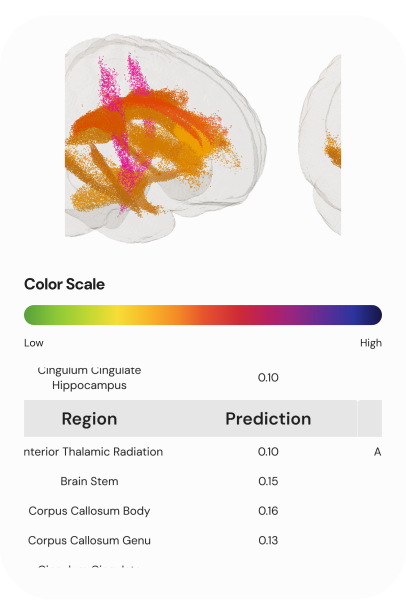
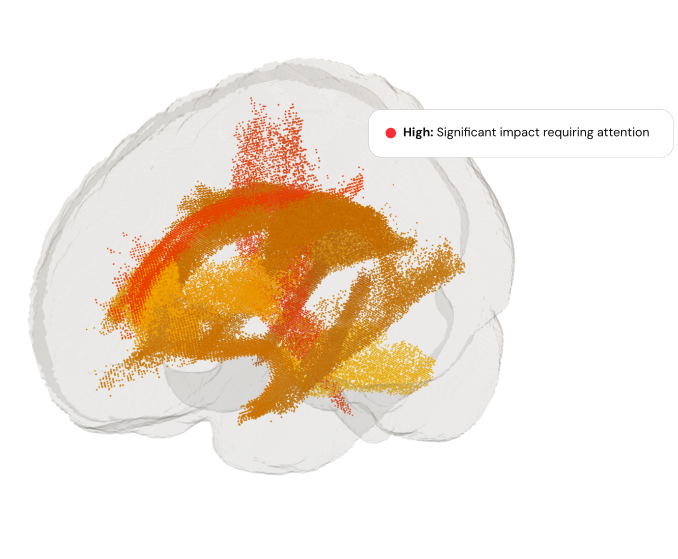
Polished voxel clouds · tonemapped · bloom + SMAA
A full finite-element brain simulation takes hours.
Trace is funded by Sports and Wellbeing Analytics (SWA), Cellbond Impact Solutions, the Royal Academy of Engineering Senior Research Fellowship, and MRC TBI-REPORTER.