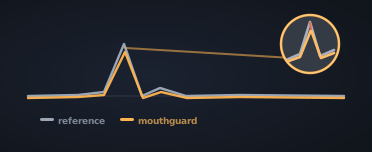
An instrumented mouthguard sounds almost too convenient: clip a couple of sensors into something athletes already wear, and read off what their head went through. The reasonable question to ask next is — how much should I believe the numbers?
The honest answer: a good iMG, well fitted, is accurate enough to be genuinely useful, but it is not a laboratory rig, and how you treat the data matters as much as the device.
What “accurate” even means here
Validation studies don’t ask “is it right?” — they ask “how close is it to a trusted reference?” Typically a mouthguard (or a headform wearing one) is struck under controlled conditions, and its readings are compared against a gold-standard sensor rigidly fixed to the skull or headform.
The numbers researchers report are things like:
- Peak error — how far off the single highest value is.
- Concordance / correlation — does the whole shape of the impact track the reference, not just the peak?
- Bias — does the device systematically read high or low?
Across the better studies, leading iMGs track reference kinematics well for linear acceleration and reasonably for rotation, with the largest errors in the noisy, derived quantities like rotational acceleration (Liu et al., 2020; Jones et al., 2023).
Why a mouthguard, specifically
The case for the teeth is mechanical. The upper jaw is rigidly coupled to the skull, so a sensor there moves with the skull — and, by extension, tracks the brain better than a helmet liner, a skin patch, or an earpiece, all of which can slide or wobble independently of the head and inflate the readings.
But “coupled to the skull” depends entirely on fit. A loosely fitted guard lets the sensor rattle against the teeth, and that relative motion shows up as spurious acceleration. This is why custom-fitted guards outperform boil-and-bite ones, and why validation results don’t automatically transfer from a tight lab fit to a real mouth mid-match (Jones et al., 2022).
The error sources that actually bite
A few recurring culprits explain most of the disagreement between an iMG and the truth:
- Coupling and fit. The biggest one. Soft-tissue movement and an imperfect seat add motion the head never experienced.
- Off-axis and sensor placement. The device measures at the mouth, but the quantities of interest are referenced to the head’s centre of mass, so the raw signal has to be transformed — and errors in assumed geometry propagate.
- Derived rotational acceleration. Most guards don’t measure this directly; they differentiate rotational velocity, which amplifies noise (Kamstra et al., 2022).
- False positives. Chewing, shouting, dropping the guard, or teeth clacking can all trip the trigger threshold and masquerade as impacts unless they’re filtered out (Jones et al., 2022).
Why the brand matters for trace*
Here’s the subtle point that’s easy to miss: trace*’s model was trained on data from one specific device — the Protecht iMG used to collect its rugby dataset. Each manufacturer has its own sensor suite, mounting, sampling rate, and on-board filtering. Feed a model kinematics from a different brand and you’ve quietly changed the input distribution it learned from.
That’s not a flaw unique to trace* — it’s a recognised challenge across the whole field, which is exactly why consensus efforts like CHAMP exist: to standardise how head-acceleration data is measured, filtered and reported so results can be compared at all (Arbogast et al., 2022). For trace*, it means a new device should have its preprocessing matched to the training device before its numbers are trusted at face value.
The takeaway
A modern, well-fitted iMG is a good instrument — accurate enough to flag big impacts, track exposure, and feed a strain model. It is not a perfect one. Treat a single eye-watering peak with suspicion, trust patterns over outliers, and remember that the device measures loading, not injury. Everything downstream — including trace* — inherits both the strengths and the limits of the sensor it started from.
Sources & further reading
- Jones, B. et al. (2022) — Ready for impact? A validity and feasibility study of instrumented mouthguards. British Journal of Sports Medicine.
- Jones, C. et al. (2023) — Validation of the Protecht instrumented mouthguard. Sensors 23 (16), 7068.
- Liu, Y. et al. (2020) — Validation and comparison of instrumented mouthguards for measuring head kinematics. Annals of Biomedical Engineering 48. — Head-to-head comparison of several iMG systems against a reference.
- Kamstra, K. et al. (2022) — Quantification of error sources with inertial measurement units in sports.
- Gabler, L. F. et al. (2021) — Development of a low-power instrumented mouthpiece for directly measuring head kinematics.
- Arbogast, K. B. et al. (2022) — Consensus Head Acceleration Measurement Practices (CHAMP): origins, methods and best practices.