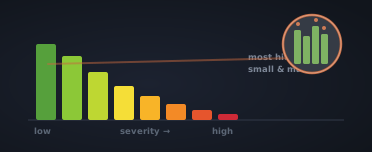
If you only logged the head impacts that led to a player coming off, you’d have a tiny, misleading dataset. The overwhelming majority of what an athlete’s head goes through in a season produces no symptoms, no stoppage, and no entry in the medic’s notebook. The case for measuring exposure rests on the idea that those quiet impacts add up — and that the total is worth counting.
The long tail of small hits
Plot every head impact in a season by severity and you get a very lopsided shape: a tall stack of small, frequent impacts on the left, trailing off to a thin scatter of big ones on the right. The big hits get all the attention. The small ones get all the volume.
These low-level events have a name in the literature — head acceleration events (HAEs), or more loosely, subconcussive impacts. Individually, none of them does anything you’d notice. The open scientific question is whether, cumulatively, they contribute to the long-term changes seen in some contact-sport athletes — and a growing body of imaging, cognitive and physiological evidence suggests they’re not harmless (Mainwaring et al., 2018).
Why the counting threshold matters so much
Here’s a subtlety that trips up almost every comparison between studies: where you set the threshold for “this counts as an impact” changes the answer enormously.
Set the trigger at 10 g and you record a modest number of meaningful events. Drop it to 5 g and the count can multiply, because there are vastly more small events than large ones. Two studies of the “same” sport can report wildly different impact counts purely because they drew the line in different places (King et al., 2016).
This is why responsible exposure reporting always states its threshold, and why raw impact counts are less interpretable than they look. trace* sidesteps part of this by reporting not just how many impacts crossed a threshold, but what each one did — its estimated strain — so a season can be summarised by tissue loading rather than by an arbitrary tally.
Exposure isn’t evenly shared
Once you start counting properly, the differences jump out:
- Position matters. Forwards and backs, linemen and receivers, accumulate very different impact profiles. Some positions take many small hits; others take fewer but larger ones (Tierney et al., 2020).
- Training vs matches. A surprising share of total exposure comes from training, not games — which is also where it’s most modifiable through coaching and contact limits.
- Individuals differ. Within the same position, players rack up very different totals, and concussed athletes have in some studies shown higher cumulative exposure than matched controls, not just one unlucky hit (Stemper et al., 2019).
That last point is the crux: it hints that the dose, accumulated over time, carries information that no single impact does.
What a season summary is for
This is the gap longitudinal monitoring is built to fill. Instrumented mouthguards make it realistic to record every qualifying event across a whole season (Patton et al., 2023), and a tool like trace* turns each one into a per-region strain estimate. Aggregate those over weeks and months and you get something the touchline never had: a picture of cumulative loading, broken down by region and by time.
The forthcoming weekly and monthly summary views of trace* are aimed squarely at this — the same impact data, added up, so the pattern becomes visible.
The honest caveat
Counting exposure is necessary, but it is not the same as predicting harm. The dose–response relationship — how much cumulative loading, of what kind, raises risk by how much, in whom — is still being mapped (Tierney, 2021). Measuring exposure carefully is precisely how the field will eventually fill that in. A heavy season is not a diagnosis, and a light one is not a guarantee. What the count gives you is an objective record — the foundation for better questions, not a verdict.
Sources & further reading
- Stemper, B. D. et al. (2019) — Comparison of head impact exposure between concussed and matched control football athletes. Annals of Biomedical Engineering 47.
- Tierney, G. et al. (2020) — Analysis of head acceleration events in collegiate-level American football.
- Tierney, G. (2021) — Concussion biomechanics, head acceleration exposure and brain injury criteria.
- King, D. et al. (2016) — The influence of head impact threshold for reporting data in contact and collision sports. Annals of Biomedical Engineering. — Why the counting threshold changes everything about the numbers.
- Patton, D. A. et al. (2023) — Quantifying head impact exposure, mechanisms and kinematics using instrumented mouthguards.
- Mainwaring, L. et al. (2018) — Subconcussive head impacts in sport: a systematic review of the evidence.